How Long Does Caffeine Stay in Your System?

How Long Does Caffeine Stay in Your System?
That morning coffee might feel like ancient history by bedtime—but some of its caffeine could still be hanging around.
So, how long does caffeine stay in your system?
Caffeine doesn’t disappear as soon as you stop feeling its effects. Your body gradually processes it over several hours, and the speed at which this happens can vary considerably from person to person.
Understanding this is particularly useful if you drink coffee, energy drinks or use caffeinated pre-workout supplements.
Let’s look at what actually happens after you consume caffeine.
How Does Caffeine Work?
Caffeine is a stimulant naturally present in coffee beans, tea leaves and several other plants. It’s also added to products such as energy drinks and some sports supplements.
One of caffeine’s main actions involves blocking receptors for adenosine, a chemical involved in promoting sleepiness.
This can temporarily make you feel more awake and alert.
If you’d like to understand where caffeine comes from, read our guide:
What Is Natural Caffeine? Sources, Effects & What to Know
How Quickly Does Caffeine Start Working?
Caffeine is absorbed relatively quickly after you consume it.
Its effects aren’t necessarily instant, however.
This is one reason people commonly drink coffee or take a caffeinated pre-workout some time before they expect to need the stimulant effect.
Exactly how noticeable those effects feel can depend on factors including:
- How much caffeine you consumed
- Your normal caffeine habits
- Your individual sensitivity
- Whether you’ve eaten
- The product you’ve consumed
What Is the Half-Life of Caffeine?
This is where things get interesting.
The half-life of something is the amount of time it takes your body to eliminate approximately half of it.
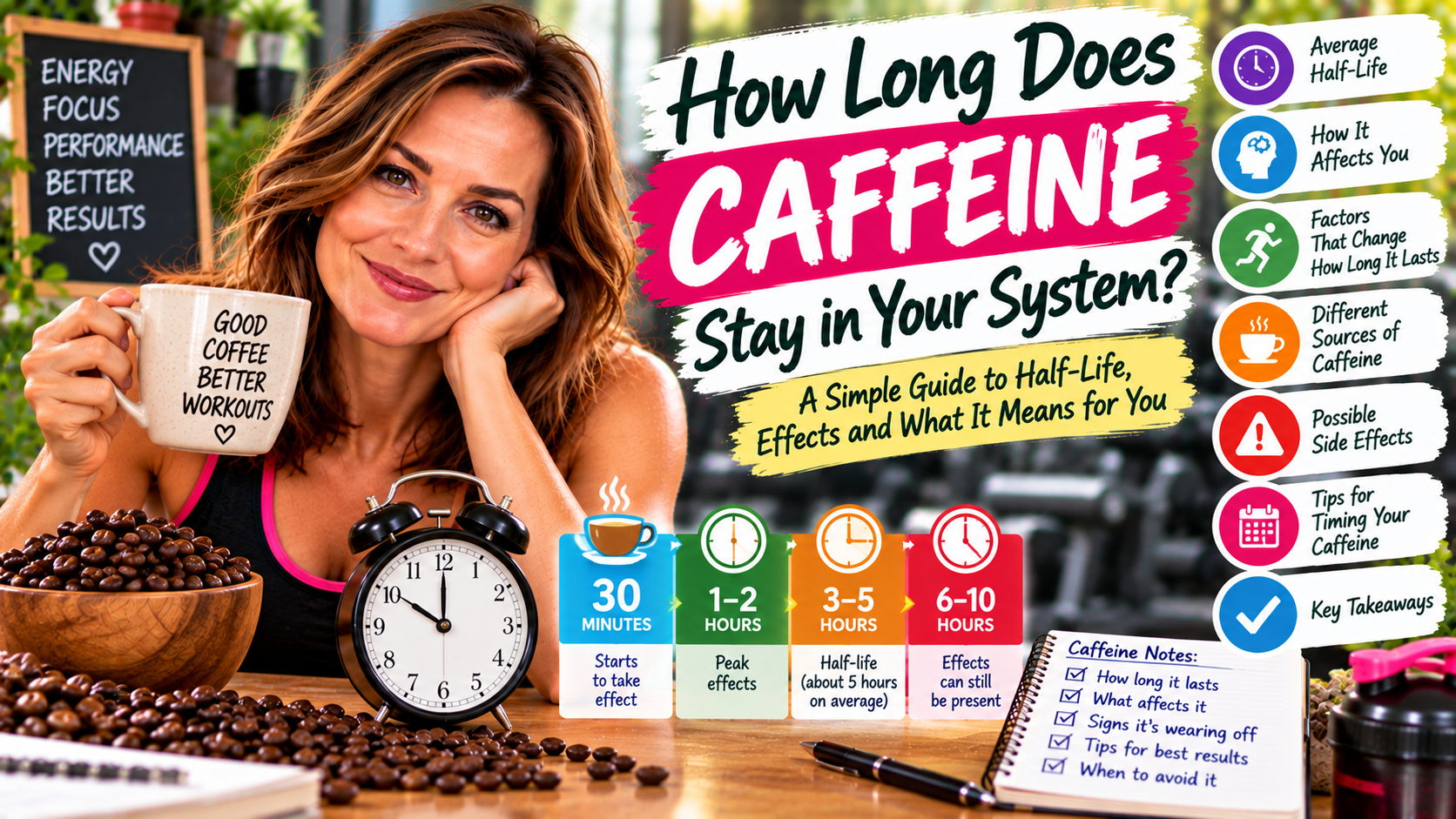
For many healthy adults, caffeine has an average half-life of roughly four to six hours, although there can be substantial individual variation.
That means caffeine doesn’t suddenly disappear after five hours.
Instead, the amount remaining gradually decreases.
☕ A Simple Caffeine Example
Imagine you consume 200 mg of caffeine at 2:00 pm.
Using a five-hour half-life purely as a simple example:
- 2:00 pm: 200 mg
- 7:00 pm: approximately 100 mg remains
- Midnight: approximately 50 mg remains
- 5:00 am: approximately 25 mg remains
This is only an illustration. Your body may process caffeine faster or slower.
So How Long Does Caffeine Stay in Your System?
The noticeable stimulant effects and the time required for your body to process caffeine aren’t necessarily the same thing.
You may stop consciously feeling particularly energised while caffeine is still present in your body.
Because caffeine is gradually eliminated rather than switched off, some of it can remain for many hours after consumption.
This is one reason the time of day you consume caffeine can matter.
Why Does Caffeine Last Longer for Some People?
There isn’t one caffeine timetable that applies perfectly to everyone.
How quickly caffeine is processed can be affected by several factors, including genetics, pregnancy, certain medicines and other individual circumstances.
Your caffeine habits can also influence how strongly you notice its effects.
Someone who rarely drinks coffee might feel a particular amount quite strongly, while someone who regularly consumes caffeine may perceive the same amount differently.
That’s why comparing your reaction to someone else’s isn’t always particularly useful.
Can Caffeine Affect Your Sleep?
Yes.
This is one of the most important reasons to understand caffeine’s half-life.
You might drink coffee during the afternoon and think:
“I’ll be fine. I don’t go to bed for hours.”
But caffeine can still be present later in the evening.
Research has found that caffeine consumed even several hours before bedtime can interfere with sleep in some circumstances.
How much it affects you depends on the amount, timing and your individual sensitivity.
If you’re struggling with sleep, looking at when you consume caffeine is a sensible place to start.
What About Caffeine Before Exercise?
Caffeine is commonly used before exercise because of its stimulant effects.
But timing becomes particularly important if you’re exercising later in the day.
An evening workout followed by bedtime a few hours later creates a trade-off worth considering: the caffeine you took for your workout may still be circulating when you’re trying to sleep.
We’ve covered this in more detail in:
Caffeine Before Exercise: Benefits, Timing & What to Know
What About Pre-Workout Supplements?
This is where checking the label becomes especially important.
Some pre-workout supplements contain caffeine, while others are stimulant-free.
If your product contains caffeine, find out how much is in one serving rather than assuming all pre-workouts are similar.
Also remember to count caffeine from everything else you’ve consumed that day.
For example:
- Morning coffee
- Tea
- Energy drinks
- Cola
- Chocolate
- Pre-workout supplements
- Other caffeinated products
It can add up surprisingly quickly.
If you’re unsure how to interpret a supplement label, see:
How to Read a Supplement Label: 10 Things to Check Before You Buy
When Should You Stop Drinking Caffeine Before Bed?
There isn’t a perfect cut-off time that works for everybody.
A person who is particularly sensitive to caffeine may need a much earlier cut-off than someone who processes it more quickly.
A practical approach is to look at your own habits.
If you’re regularly consuming caffeine later in the day and struggling to fall asleep or stay asleep, try moving your last caffeinated drink earlier and see whether your sleep improves.
Remember that an afternoon coffee isn’t the only possible source.
Your evening pre-workout could contain a significant amount too.
Is Morning Caffeine Better?
If caffeine affects your sleep, consuming it earlier in the day gives your body more time to process it before bedtime.
That doesn’t mean everybody needs to restrict caffeine to the morning.
Instead, think about the relationship between:
Amount + timing + your sensitivity.
Those three things matter much more than simply labelling caffeine “good” or “bad.”
Does More Caffeine Mean More Energy?
Not necessarily.
It’s easy to fall into the trap of thinking:
“If one coffee wakes me up, two must work twice as well.”
That’s not a particularly useful way to think about caffeine.
Higher amounts can increase the likelihood of unwanted effects such as:
- Jitters
- Restlessness
- Difficulty sleeping
- Feeling anxious or uncomfortable
- Heart palpitations in susceptible people
More isn’t automatically better.
How Much Caffeine Is Considered Safe?
According to the European Food Safety Authority (EFSA), single doses of caffeine up to 200 mg generally don’t raise safety concerns for healthy adults.
EFSA also states that caffeine intakes from all sources of up to 400 mg per day, consumed throughout the day, generally don’t raise safety concerns for healthy adults other than pregnant women.
Those figures shouldn’t be treated as targets.
Some people experience unwanted effects at considerably lower amounts.
Pregnant or breastfeeding women and people with certain medical conditions or taking particular medicines should seek appropriate professional guidance.
Can You Speed Up Caffeine Leaving Your System?
Once you’ve consumed caffeine, there isn’t a magic drink or trick that instantly removes it from your body.
Your liver needs time to metabolise it.
Drinking water is important for normal hydration, but it doesn’t suddenly cancel the caffeine you’ve consumed.
The simplest strategy is therefore prevention:
Know how much caffeine you’re consuming and think about when you’re consuming it.
Coffee vs Pre-Workout
If you’re consuming caffeine specifically before exercise, you might wonder whether you need a pre-workout supplement at all.
Coffee can provide caffeine too, but pre-workout products may contain additional ingredients designed around exercise.
We’ve compared them here:
Coffee vs Pre-Workout: What’s the Difference?
What If You Take Pre-Workout but Don’t Exercise?
The caffeine doesn’t disappear just because you skipped your workout.
If you’ve already taken a caffeinated pre-workout, those ingredients will still be processed by your body.
That’s something worth remembering before reaching for another coffee or energy drink later.
Read our complete guide:
Can You Take Pre-Workout Without Exercising?
🔎 Emma Investigates: The Caffeine Check
When I’m looking at an energy or pre-workout supplement, one of the first things I want to know is:
How much caffeine am I actually getting?
Don’t let words such as energy, natural or performance distract you from the numbers on the label.
Look at:
- Caffeine per serving
- The actual serving size
- How many servings you’re consuming
- Other sources of caffeine you’re having that day
- What time you’re taking it
We’ll use exactly this approach when we investigate products such as TRUWILD Motion.
Emma’s Quick Caffeine Checklist
Before reaching for another caffeinated drink, ask yourself:
- ☑ How much caffeine have I already had today?
- ☑ What time is it?
- ☑ When am I planning to sleep?
- ☑ Does my pre-workout contain caffeine?
- ☑ Am I actually tired because I need rest, food or hydration?
- ☑ Do I really need another caffeine hit?
The Bottom Line
So, how long does caffeine stay in your system?
Caffeine has a half-life of several hours for many adults, which means your body can still contain caffeine long after the obvious stimulating feeling has faded.
That’s particularly important when you’re consuming caffeine later in the day.
Rather than obsessing over one perfect caffeine cut-off time, pay attention to three things:
How much you’re consuming, when you’re consuming it, and how your own body responds.
And remember: feeling tired isn’t always your body’s way of asking for more caffeine.
Sometimes it’s asking for something considerably less exciting.
Sleep.
Health disclaimer: This article is for general educational purposes and isn’t medical advice. Individual responses to caffeine vary. If you’re pregnant, breastfeeding, taking medication, have a medical condition, or are concerned about your caffeine intake, speak with an appropriately qualified healthcare professional.