Can You Take Pre-Workout Without Exercising? What to Know

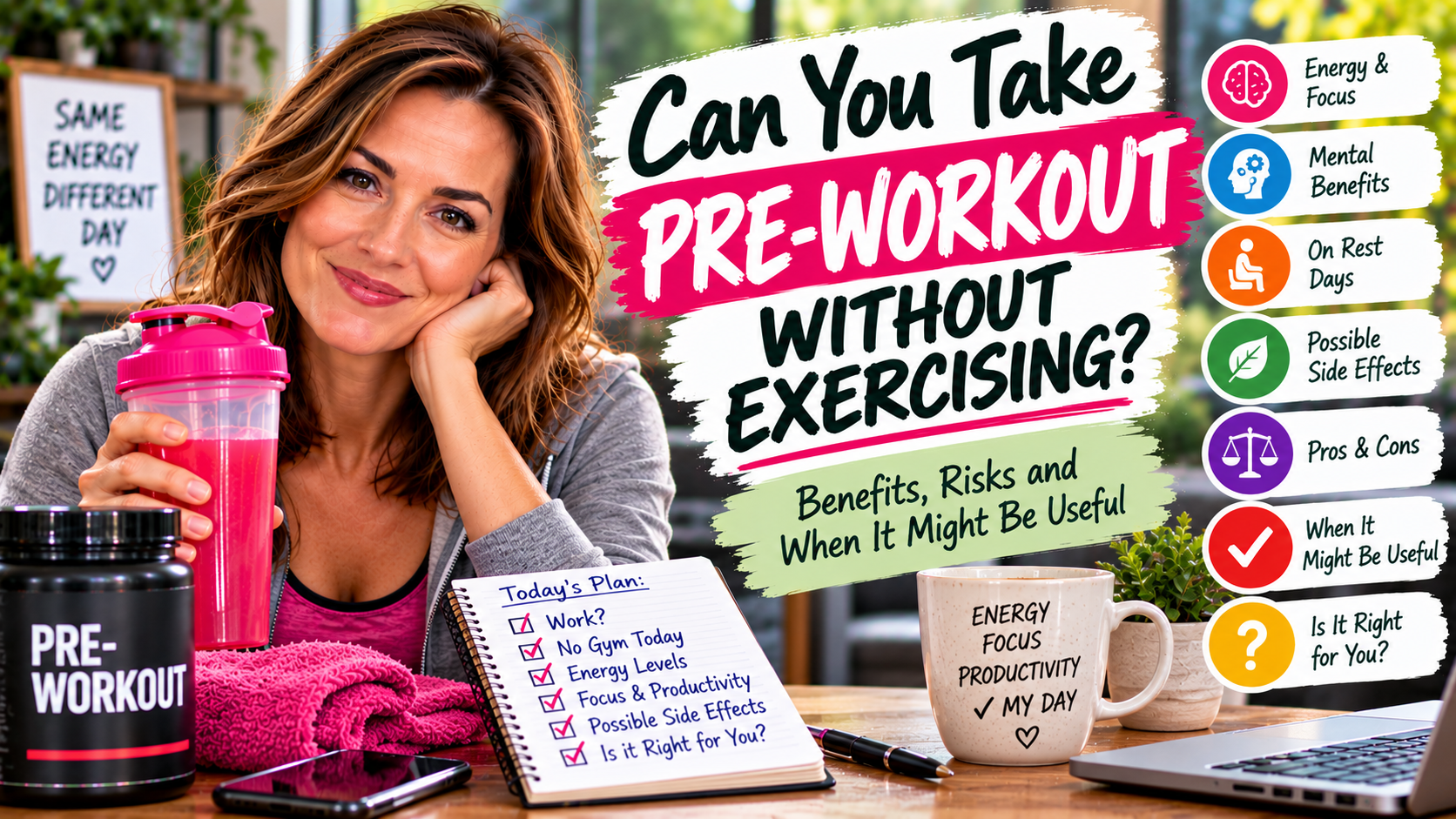
Can You Take Pre-Workout Without Exercising? What to Know
Pre-workout supplements are designed to be taken before exercise, but what happens if you take one and then don’t actually work out?
Maybe your plans changed after you’d already mixed your drink. Or perhaps you’re wondering whether a pre-workout could simply replace your morning coffee and give you an energy boost on a busy day.
Technically, you can take a pre-workout without exercising, but that doesn’t necessarily mean there’s a good reason to.
Let’s look at what’s actually happening.
What Is Pre-Workout?
Pre-workout is a broad term for supplements designed to be consumed before physical activity.
There’s no single formula used in every product. Depending on the supplement, ingredients might include:
- Caffeine
- Amino acids
- Beta-alanine
- Creatine
- Electrolytes
- Vitamins and minerals
- Plant extracts and flavourings
Some products contain several of these ingredients, while others have relatively simple formulas.
If you’re completely new to these products, start with our guide What Is Pre-Workout and What Does It Do?
What Happens If You Take Pre-Workout and Don’t Exercise?
Your body doesn’t suddenly ignore the ingredients because you haven’t gone to the gym.
If your pre-workout contains caffeine, for example, you’ll still consume the caffeine whether you’re sitting at your desk or doing squats.
You might therefore notice increased alertness or feel more awake. Depending on the ingredients and your individual sensitivity, you could also experience unwanted effects such as feeling restless or jittery.
The important point is that the supplement doesn’t know whether you’re exercising.
Its ingredients enter your body regardless.
Will Pre-Workout Give You Energy Without Exercise?
This depends heavily on what is in the product.
Many pre-workout supplements contain caffeine, which acts as a stimulant and can increase alertness. That’s one reason people often associate pre-workout with feeling more energetic.
But it’s worth making an important distinction.
Pre-workout isn’t creating unlimited energy. If you’ve slept badly, haven’t eaten properly or are dehydrated, a stimulant may make you feel more alert without addressing the reason you’re tired.
That’s why I wouldn’t automatically reach for a pre-workout every time you feel sluggish.
Is It Like Drinking Coffee?
There can be similarities.
A cup of coffee and a caffeinated pre-workout can both provide caffeine, but a pre-workout may contain several additional ingredients.
That’s one reason it’s worth asking yourself:
What am I actually trying to get from this product?
If you simply want some caffeine while working at your computer, coffee may be the simpler option.
We’ve compared the two in more detail in Coffee vs Pre-Workout: What’s the Difference?
What About Caffeine?
This is one of the biggest things to check.
The caffeine content of pre-workout products can vary considerably, so don’t assume one scoop of every product is equivalent.
Check the label.
You should also consider all the other caffeine you’re consuming during the day, including coffee, tea, energy drinks and other supplements.
For healthy adults, the European Food Safety Authority says single doses of caffeine up to 200 mg generally don’t raise safety concerns, and habitual consumption up to 400 mg per day generally doesn’t raise safety concerns for healthy non-pregnant adults. Individual sensitivity varies, and lower limits apply in pregnancy.
That isn’t a target to aim for—it is safety guidance.
For more on caffeine itself, see What Is Natural Caffeine? Sources, Effects & What to Know.
What If You Intended to Exercise but Changed Your Mind?
This is probably one of the most realistic scenarios.
You’ve taken your pre-workout and then something happens—the gym closes, your plans change, the phone rings, or suddenly the sofa develops an unusually powerful gravitational field.
Don’t panic.
Check what you’ve consumed, particularly the caffeine content, and avoid unnecessarily stacking additional caffeinated products on top of it.
If you feel perfectly well, there’s usually no reason to exercise simply because you’ve taken a supplement.
If you experience significant or concerning symptoms after taking a supplement, seek appropriate medical advice.
Can You Use Pre-Workout as a General Energy Drink?
I wouldn’t make this the default purpose of a pre-workout.
Products formulated for exercise can contain ingredients you simply don’t need while spending the afternoon answering emails.
And if you’re regularly relying on highly caffeinated products to get through ordinary days, it’s worth looking at the bigger picture: sleep, hydration, nutrition and your overall caffeine intake.
Supplements shouldn’t become a substitute for the basics.
Can You Take Pre-Workout on a Rest Day?
Again, it depends on the product.
Some ingredients commonly found in sports supplements may be consumed daily depending on their intended use, while other ingredients are included primarily because they’re useful around exercise.
So rather than treating every pre-workout the same way, look at the individual ingredients and manufacturer’s directions.
Our guide How to Read a Supplement Label: 10 Things to Check Before You Buy will help you understand what you’re looking at.
Could Pre-Workout Affect Your Sleep?
Yes—particularly if it contains caffeine.
Caffeine can remain in the body for hours, which means an afternoon or evening pre-workout could potentially interfere with sleep in some people.
And there’s an unfortunate cycle worth avoiding:
Poor sleep → tired the next day → more caffeine → poorer sleep → even more caffeine.
If you exercise later in the day, caffeine content is something I’d pay particularly close attention to.
You can also read When Should You Take Pre-Workout? Timing Explained for more on this.
What About Caffeine-Free Pre-Workout?
Not every pre-workout contains caffeine.
A stimulant-free product may contain ingredients aimed at hydration, exercise performance or other purposes without providing the stimulant effect associated with caffeine.
But the same principle applies: check what’s actually in the product rather than judging it by the words “pre-workout” on the front.
Two products carrying that description can have very different formulas.
Do You Actually Need Pre-Workout?
No.
You don’t need a pre-workout supplement in order to exercise.
Plenty of people train perfectly well without one.
Sleep, food, hydration and a sensible exercise routine matter far more than owning a tub of brightly coloured powder.
A pre-workout is something you might choose to use—not something your body requires before exercising.
Emma’s Pre-Workout Checklist
Before taking one, I’d ask:
What’s in it?
Read the ingredient list.
How much caffeine does it contain?
Don’t forget caffeine you’ve consumed elsewhere.
Why am I taking it?
Exercise? Alertness? Habit?
What time is it?
Consider whether caffeine could interfere with your sleep.
Am I following the serving directions?
More isn’t automatically better.
Do I actually need it today?
Sometimes water, food, rest—or a normal cup of coffee—is the simpler answer.
Emma Investigates
One thing you’ll notice throughout Emma Hart Wellness is that we don’t judge a supplement by the promises on the front of the tub.
We turn it around and look at what’s actually inside it.
That’s exactly what we’ll be doing with TRUWILD Motion in an upcoming Emma Investigates review.
We’ll examine its ingredients, caffeine content, serving information and claims so you can understand what you’re actually buying rather than simply being told whether a product is “good” or “bad.”
The Bottom Line
So, can you take pre-workout without exercising?
Yes. The ingredients will still affect your body even if you don’t exercise.
But if you’re simply looking for everyday alertness, there may be little reason to use a product specifically formulated for exercise—particularly if it contains several active ingredients when all you actually wanted was caffeine.
The better question isn’t necessarily “Can I take it?”
It’s:
“What am I taking it for, and what’s actually in it?”
That’s a much more useful way to approach supplements.
This article is for general educational purposes and isn’t medical advice. Supplements may not be suitable for everyone and can interact with medicines or medical conditions. Follow the manufacturer’s directions and speak with a qualified healthcare professional if you’re unsure whether a supplement is appropriate for you.