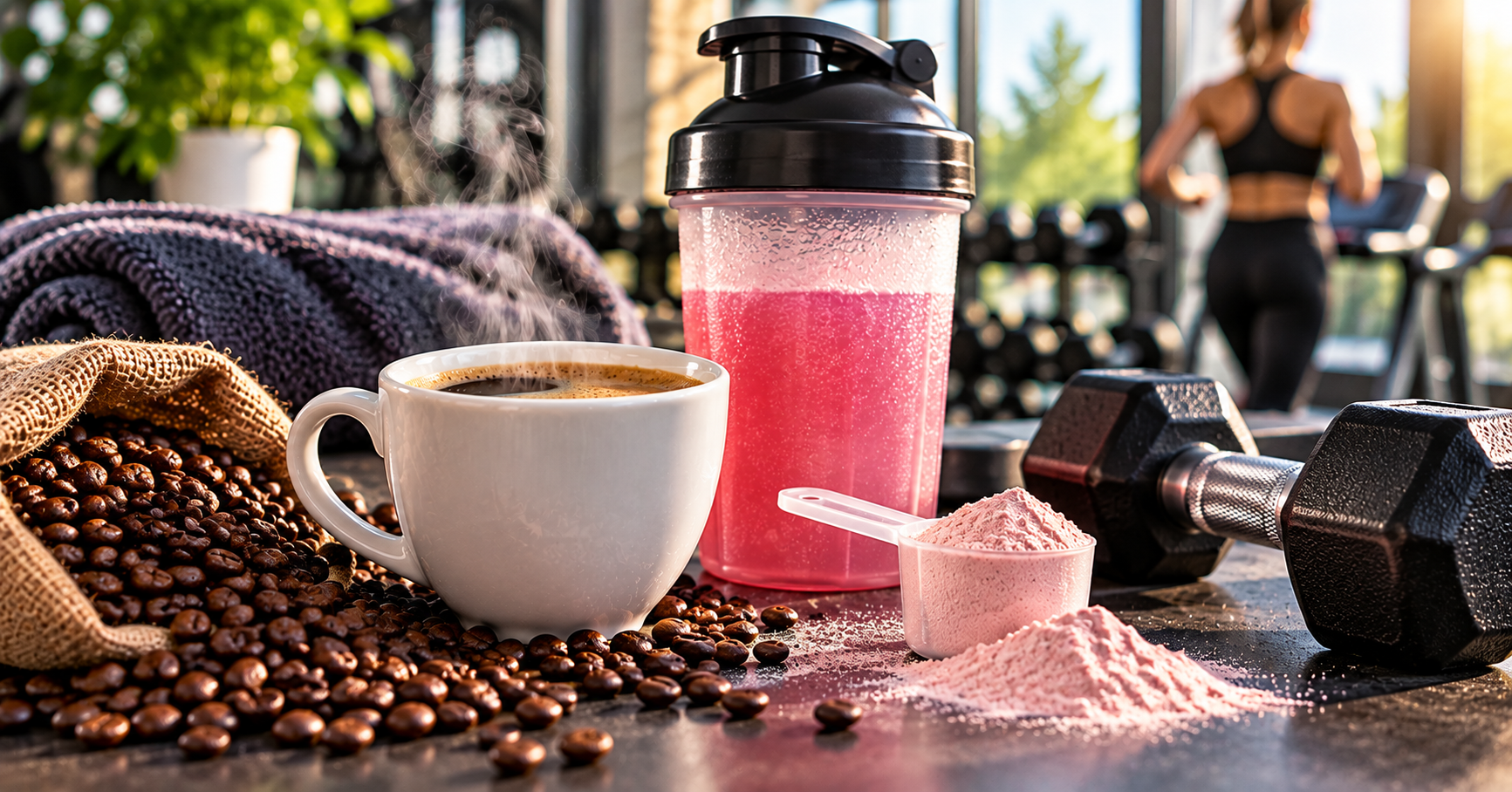
Caffeine Before Exercise

Caffeine Before Exercise: Benefits, Timing & What to Know
Coffee before the gym?
A caffeinated pre-workout?
Or perhaps an energy drink on the way to training?
Caffeine has become incredibly common in the fitness world.
But does caffeine before exercise actually help — and if it does, when should you take it?
Let’s make it simple.
Why Do People Take Caffeine Before Exercise?
Caffeine is a stimulant that affects the central nervous system.
For many people, the most familiar effect is feeling more alert after drinking coffee.
But caffeine has also been extensively studied in relation to exercise.
Research suggests caffeine can improve certain aspects of physical performance in some people.
That doesn’t mean caffeine automatically gives everyone a better workout.
The effect depends on factors including the activity, dose and individual.
Can Caffeine Improve Exercise Performance?
It can in some circumstances.
Research reviewed by the US National Institutes of Health suggests caffeine may improve performance in endurance activities and sports involving periods of sustained or intermittent activity.
The evidence is particularly strong for endurance-type exercise.
However, there’s an important phrase there:
“May improve.”
People respond differently to caffeine.
Some people notice a significant effect.
Others notice relatively little.
And some dislike the effects altogether.
So don’t assume that because your training partner swears by a double espresso before exercising, you’ll respond exactly the same way.
How Does Caffeine Work During Exercise?
One of caffeine’s important actions involves adenosine.
Adenosine is involved in processes that contribute to feelings of tiredness.
Caffeine can bind to adenosine receptors and block some of adenosine’s effects.
This can increase alertness and reduce perceived fatigue.
Research also suggests caffeine can reduce perceived exertion.
In plain English:
The same exercise may feel a little less difficult for some people after consuming caffeine.
That’s one reason caffeine is so widely used in sports nutrition.
When Should You Have Caffeine Before Exercise?
You’ll frequently hear:
“Take caffeine 30–60 minutes before training.”
There’s some logic behind that.
Caffeine is absorbed relatively quickly, and research commonly uses caffeine before exercise.
The NIH notes that caffeine reaches peak concentrations in the blood at around 45 minutes after consumption and that sports-performance studies commonly use it approximately 15–60 minutes before exercise.
However, the ideal timing isn’t identical for every caffeine source.
Coffee, capsules, chewing gum and pre-workout drinks aren’t necessarily consumed or absorbed in exactly the same way.
So don’t become obsessed with hitting an exact minute.
How Much Caffeine Is Used in Exercise Research?
This is where things get interesting.
Research into sports performance has often examined doses based on body weight.
The NIH reports that many studies showing potential performance benefits have used approximately 2–6 mg of caffeine per kilogram of body weight before exercise.
For someone weighing 70 kg, that’s roughly:
140–420 mg of caffeine.
But this absolutely does not mean everyone should take 420 mg before exercising.
Higher amounts don’t necessarily produce better performance and can increase the likelihood of unwanted effects.
More isn’t automatically better.
How Much Caffeine Is Safe?
For healthy adults, the European Food Safety Authority states that single doses of up to 200 mg generally don’t raise safety concerns, including when consumed less than two hours before intense physical exercise under normal environmental conditions.
EFSA also states that caffeine intake up to 400 mg throughout the day generally doesn’t raise safety concerns for healthy adults, excluding pregnant women.
These are safety reference levels.
They are not targets you should try to reach.
Some people experience unwanted effects at considerably lower amounts.
What Are the Possible Side Effects?
Caffeine can cause unwanted effects, particularly at higher doses or in people who are sensitive to it.
These can include:
- Feeling jittery
- Restlessness
- Difficulty sleeping
- Nausea
- Anxiety
- Increased heart rate
- Headaches
If caffeine makes you feel awful, the fact that it might improve somebody else’s workout isn’t particularly relevant.
Listen to your body rather than copying someone else’s supplement routine.
Coffee or Pre-Workout?
This is a question we’ll explore properly in another Emma Hart Wellness article.
But here’s the basic difference.
Coffee
Coffee naturally contains caffeine along with numerous other compounds.
It’s inexpensive, familiar and widely available.
However, the exact caffeine content of a cup can vary depending on the coffee, serving size and preparation.
Pre-Workout
A pre-workout product may combine caffeine with several other ingredients.
That might include amino acids, electrolytes, vitamins, plant extracts or other substances depending on the formula.
This means comparing coffee with pre-workout isn’t simply:
Coffee vs caffeine.
It’s more like:
Coffee vs an entire supplement formulation.
That’s why reading the label matters.
Does More Caffeine Mean a Better Workout?
No.
This is one of the biggest mistakes I’d avoid.
If one product contains 150 mg of caffeine and another contains 300 mg, that doesn’t automatically make the 300 mg product twice as good.
Research indicates that taking more caffeine beyond useful amounts doesn’t necessarily improve performance further.
Meanwhile, unwanted effects become more likely as intake increases.
So don’t judge a pre-workout by how aggressively caffeinated it is.
What About Your Other Caffeine?
This is easy to forget.
Imagine you’ve already had:
Morning coffee
↓
Another coffee at work
↓
Tea after lunch
↓
Pre-workout before the gym
You need to consider caffeine from all sources, not just the supplement you’re holding.
That’s why reading labels is so useful.
If you haven’t already, read:
How to Read a Supplement Label: 10 Things to Check Before You Buy
It explains exactly what I look for when examining supplements.
Can Caffeine Affect Your Sleep?
Definitely something to consider.
Caffeine’s effects don’t disappear when your workout ends.
The NIH reports a caffeine half-life of approximately 4–5 hours, although this can vary between individuals.
A half-life means the approximate time required for your body to eliminate half of the caffeine.
So imagine taking a caffeinated pre-workout for an evening gym session.
Some of that caffeine could still be circulating several hours later when you’re trying to sleep.
EFSA also notes that even 100 mg of caffeine close to bedtime may affect sleep duration and sleep patterns in some adults.
That creates an interesting trade-off.
Taking caffeine might help today’s workout.
But disrupting tonight’s sleep isn’t necessarily helpful for tomorrow.
Should You Exercise Without Caffeine Sometimes?
Absolutely.
You don’t need caffeine to exercise.
Food, hydration, sleep and appropriate training matter far more to your overall fitness.
Caffeine should never become something you feel you must have simply to get through a normal workout.
If you’re constantly exhausted before exercising, it might be worth looking at why you’re tired rather than automatically increasing your stimulant intake.
What Should You Check in a Caffeinated Pre-Workout?
Before buying one, I’d ask five questions:
1. How much caffeine is in one serving?
Don’t guess.
Check the label.
2. What’s the serving size?
Is it one scoop or two?
3. Where is the caffeine coming from?
Coffee extract?
Tea?
Guarana?
Added caffeine?
4. What else does the product contain?
Caffeine is rarely the only ingredient in a pre-workout.
5. When am I going to use it?
If you usually train at 8pm, caffeine may deserve more consideration than if you train at 8am.
Emma Investigates: Putting This Into Practice
We’re building towards our first full Emma Investigates product breakdown.
The product is:
TRUWILD Motion.
Rather than starting with:
“Is TRUWILD Motion good?”
I’m going to ask better questions.
How much caffeine does it contain?
Where does that caffeine come from?
What other ingredients are included?
How much does each serving cost?
What claims does the manufacturer make?
And what should you consider before buying it?
We’ll then compare what we find with the research we’ve been discussing in these guides.
That’s how I want product reviews on Emma Hart Wellness to work.
Information first. Affiliate link second.
Frequently Asked Questions
Is caffeine good before exercise?
Research suggests caffeine can improve certain aspects of exercise performance for some people, particularly endurance-type activities. However, individual responses vary.
How long before exercising should I have caffeine?
Research commonly uses caffeine approximately 15–60 minutes before exercise, although timing can depend on the caffeine source and individual.
Is coffee good before a workout?
Coffee can provide caffeine before exercise. However, caffeine content varies between different coffees and serving sizes.
Is 200 mg of caffeine a lot?
It depends on the person and their other caffeine intake. EFSA states that single doses up to 200 mg generally don’t raise safety concerns for healthy adults, but some people experience effects at considerably lower amounts.
Can caffeine before exercise affect sleep?
Yes. Particularly if it’s consumed later in the day. Caffeine remains in the body for several hours and may interfere with sleep in some people.
Do I need caffeine to exercise?
No. Caffeine isn’t necessary for exercise or fitness.
The Bottom Line
Caffeine is one of the better-researched ingredients used in sports nutrition.
Evidence suggests it can improve certain aspects of exercise performance for some people, particularly endurance activities.
But that doesn’t mean:
More caffeine = better workout.
Consider the amount.
Consider your other caffeine intake.
Consider what time you’re exercising.
And most importantly, consider how you respond to caffeine.
A supplement should complement the basics.
It shouldn’t replace them.
Important Information
This article is provided for general educational purposes and isn’t medical advice. Caffeine and performance supplements aren’t suitable for everyone. If you’re pregnant, breastfeeding, taking medication, have a health condition or aren’t sure whether caffeine is appropriate for you, seek advice from an appropriately qualified healthcare professional.
The evidence behind this article is fairly strong compared with many supplement ingredients. The NIH reports that caffeine may improve endurance and some other exercise performance at commonly studied doses, but responses vary and taking more doesn’t necessarily improve results. Office of Dietary Supplements EFSA states that single doses up to 200 mg generally don’t raise safety concerns for healthy adults, even less than two hours before intense exercise under normal conditions; it also notes that 100 mg close to bedtime can affect sleep in some adults.