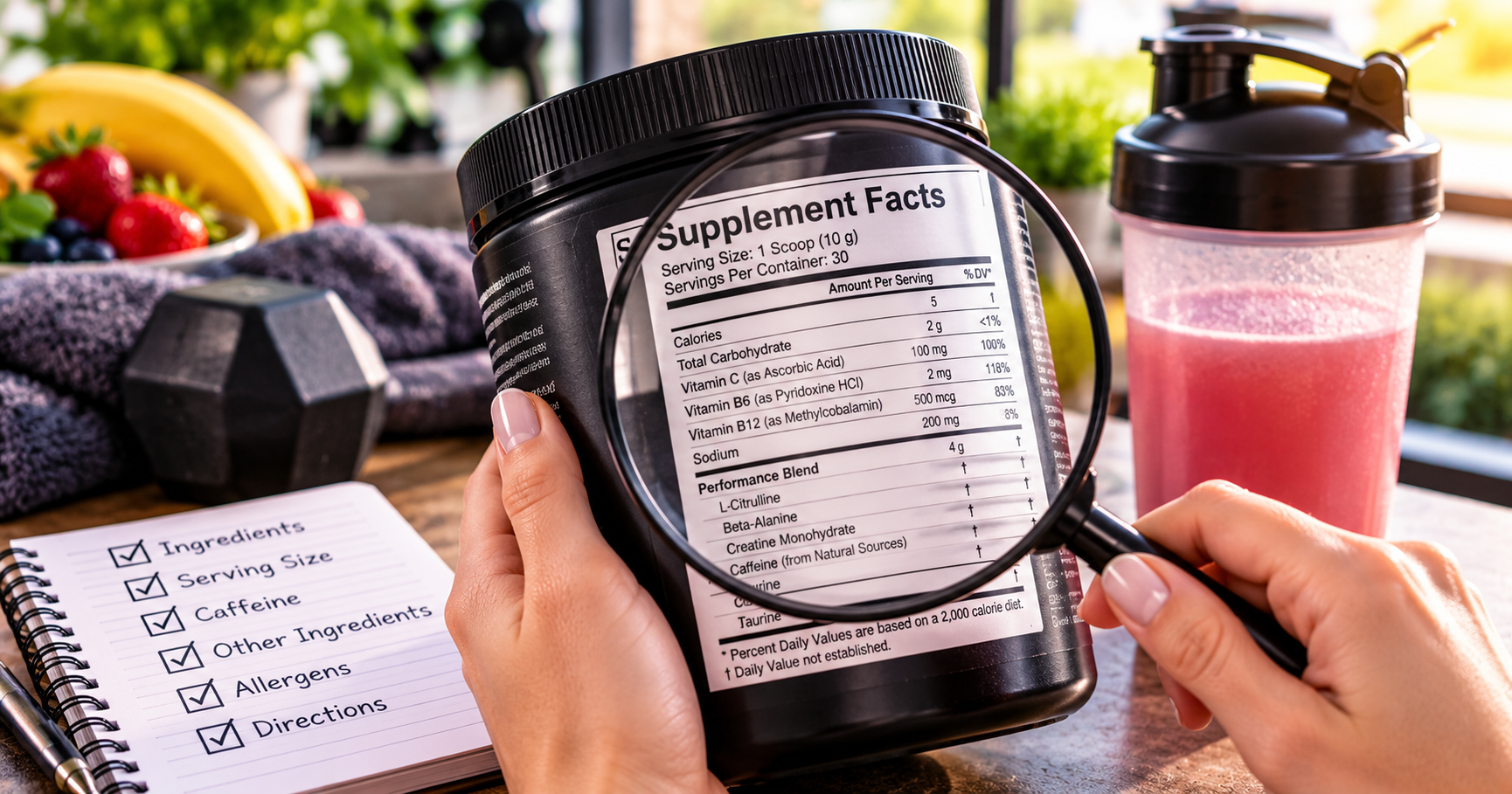
How to Read a Supplement Label

How to Read a Supplement Label: 10 Things to Check Before You Buy
Supplement labels can be confusing.
One bottle tells you it’s “advanced.” Another is “premium.” Another has a long list of ingredients you’ve never heard of.
But here’s something I’ve learned when looking at wellness products:
The most impressive words are usually on the front. The useful information is often on the back.
So before buying a supplement, turn the bottle around.
Here are 10 things worth checking.
1. Start With the Serving Size
This is one of the easiest things to overlook.
You might see a large number on the label and assume that’s how much you’re getting in one capsule or scoop.
Not necessarily.
The amount may be based on two capsules, three gummies or multiple scoops.
For example, imagine a product advertises:
500 mg per serving
That sounds straightforward.
But if one serving requires four capsules, you’re actually getting 125 mg per capsule.
That’s why the first question I ask is:
What’s considered one serving?
It also helps you work out how long the container will actually last.
2. Look at the Amount of Each Ingredient
Finding an ingredient you recognise isn’t enough.
You also want to know how much of it the product contains.
This is particularly useful when comparing two supplements.
Product A and Product B might both contain the same ingredient, but that doesn’t mean they’re equivalent.
Look for the amount provided per serving.
3. Understand What % Daily Value Means
Some vitamins and minerals will have a percentage next to them.
This is usually shown as % Daily Value on US supplement labels.
It helps indicate how much a serving contributes towards the established daily value for that nutrient.
If something provides 100% of the Daily Value, that doesn’t mean it’s “100% effective.”
Those are completely different things.
It’s nutritional information — not a product rating.
4. Don’t Panic When There’s No Daily Value
You may see an ingredient followed by something like:
Daily Value not established.
That doesn’t automatically mean there’s something wrong with the ingredient.
Not every dietary ingredient has an established Daily Value.
This is common with certain botanical ingredients and other substances used in supplements.
Again, the important thing is understanding what the label actually tells you rather than assuming a blank percentage means either “good” or “bad.”
5. Look Beyond the Main Ingredients
Don’t stop reading when you reach the ingredients you recognise.
Look for the Other Ingredients section too.
This can contain things such as:
- Flavourings
- Sweeteners
- Colourings
- Fillers
- Binders
- Capsule materials
These aren’t necessarily something to worry about.
They’re simply part of understanding what you’re consuming.
This can be particularly important if you have allergies, intolerances or dietary requirements.
6. Pay Attention to Caffeine
This one is especially relevant to the energy and pre-workout products we’re going to investigate on Emma Hart Wellness.
If a product contains caffeine, find out how much you’re getting per serving.
Then think about everything else you’re consuming.
Coffee.
Tea.
Energy drinks.
Chocolate.
Other supplements.
Your total caffeine intake doesn’t begin and end with one product.
And if you’re exercising later in the day, remember that caffeine can remain in your system for hours.
That’s one reason I wouldn’t judge a pre-workout simply by how powerful the manufacturer says it feels.
More caffeine isn’t automatically better.
7. Be Careful With Big Front-Label Claims
This is probably my favourite rule.
Ignore the front of the bottle for a minute.
Words such as:
Advanced
Ultimate
Premium
Revolutionary
Super
may sound impressive, but they don’t tell you very much about what’s actually inside the product.
Instead, turn the package around and look at:
Ingredients → Amounts → Serving size → Directions → Warnings
That’s much more useful.
8. Check the Directions
How is the manufacturer telling you to use the product?
Once daily?
Before exercise?
With food?
Mixed with water?
The directions matter because they help you understand how the manufacturer intends the product to be used.
They also let you calculate something that’s surprisingly important:
How many days will the container last?
A tub containing 30 scoops doesn’t necessarily provide 30 days’ supply if the recommended use involves more than one scoop per day.
And a bottle containing 90 capsules isn’t necessarily a three-month supply if the serving is three capsules.
That brings us to something affiliate reviews sometimes conveniently forget.
Price per serving.
I’ll be including that whenever possible in Emma’s product reviews.
9. Look for Warnings
Don’t skip the small print.
Supplements aren’t automatically suitable for everyone just because they’re available without a prescription.
Pay attention to warnings concerning things such as age, pregnancy, breastfeeding, medications, medical conditions and stimulant ingredients.
If you’re taking medication, have an existing health condition or aren’t sure whether an ingredient is appropriate for you, speak to an appropriately qualified healthcare professional.
10. Remember What the Label Can’t Tell You
Here’s perhaps the most important point.
A professional-looking label doesn’t prove that a supplement works.
It doesn’t tell you everything about product quality either.
A supplement could have beautiful packaging, a long ingredient list and impressive marketing without that automatically meaning it’s the right product for you.
That’s why when we investigate products on Emma Hart Wellness, we’ll look beyond the packaging.
We’ll ask:
What’s actually in it?
How much does it contain?
What claims are being made?
What evidence exists for the relevant ingredients?
How much does it cost per serving?
And what should you know before buying it?
A Simple Supplement Label Checklist
The next time you’re looking at a supplement, remember these five questions:
1. What’s the serving size?
2. What ingredients does it contain?
3. How much of each ingredient am I getting?
4. What are the directions and warnings?
5. Does the evidence support the claims being made?
If you can’t answer those questions, don’t let a clever advert rush you into buying.
Take five minutes and investigate.
How This Applies to Pre-Workout Supplements
This becomes particularly useful with pre-workout products because formulas can contain several ingredients.
If you haven’t already read it, take a look at:
What Is Pre-Workout and What Does It Do?
That’s where I’ve explained some of the common ingredients you’ll encounter and what pre-workout actually means.
We’re also going to put these label-reading rules into practice when Emma Investigates TRUWILD Motion.
Instead of simply saying whether a product is “good” or “bad,” we’ll examine what’s actually inside it.
That’s a much more useful way to make a decision.
The Bottom Line
Don’t choose a supplement because the front of the bottle looks impressive.
Turn it around.
Check the serving size