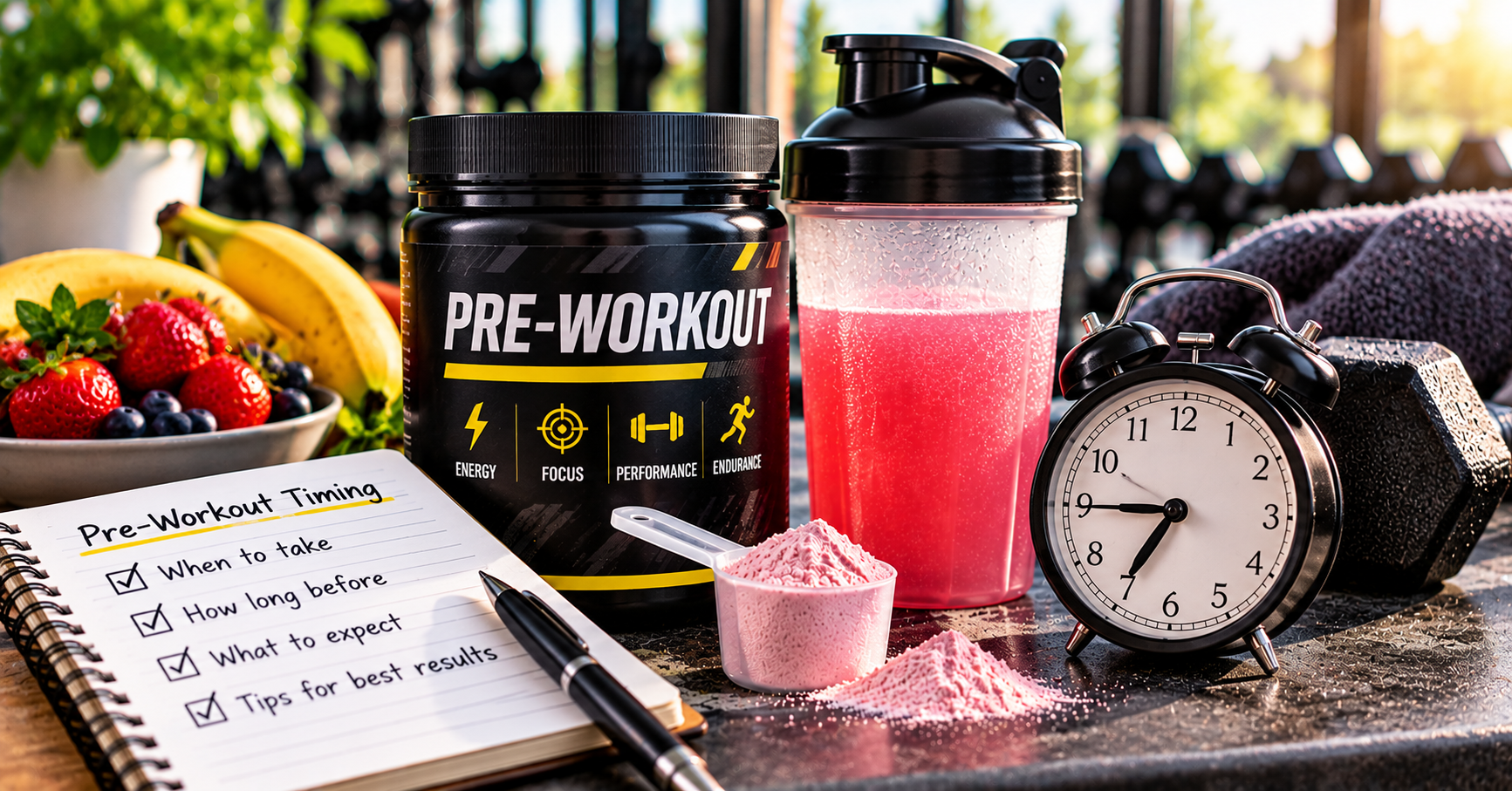
When Should You Take Pre-Workout

When Should You Take Pre-Workout? Timing Explained
You’ve bought a pre-workout.
You’re heading to the gym.
Now comes the obvious question:
When should you actually take it?
You’ll often hear people say:
“Take your pre-workout 30 minutes before training.”
That’s a reasonable starting point for many products, but the complete answer isn’t quite that simple.
The best timing depends on what’s actually in your pre-workout — particularly whether it contains caffeine.
Let’s take a closer look.
What Is Pre-Workout?
Pre-workout is a broad category of supplements designed to be consumed before exercise.
Different products can have very different formulas.
Some contain caffeine.
Others are stimulant-free.
Depending on the product, you may also find ingredients such as:
- Beta-alanine
- Creatine
- Amino acids
- Electrolytes
- Vitamins
- Plant extracts
That’s why there isn’t one perfect timing rule that applies to every pre-workout.
If you’re completely new to these products, start with my guide:
What Is Pre-Workout and What Does It Do?
When Should You Take Pre-Workout?
Many pre-workout manufacturers recommend consuming their product shortly before exercise.
You’ll commonly see instructions somewhere around 15–30 minutes before training, although directions vary.
Caffeine research also gives us some useful context.
Caffeine is absorbed relatively quickly, and sports-performance research frequently involves caffeine being consumed before exercise.
However, that doesn’t mean you need to stand outside the gym with a stopwatch.
The important thing is to:
Check your product’s directions.
Different formulations aren’t necessarily intended to be used in exactly the same way.
Why Is 30–60 Minutes Before Exercise Often Mentioned?
A lot of the discussion around pre-workout timing comes from caffeine.
Caffeine levels in the blood generally rise relatively quickly after consumption.
Research into caffeine and exercise has often involved taking caffeine roughly 30–60 minutes before activity, although timing can vary depending on how it’s consumed.
That’s why this window has become so familiar in fitness circles.
But there’s an important distinction:
Caffeine timing isn’t automatically the same as optimal timing for every ingredient in a pre-workout.
A pre-workout may contain several ingredients with completely different characteristics.
Does Pre-Workout Work Immediately?
Don’t expect every pre-workout to produce an instant sensation.
If it contains caffeine, you may gradually notice increased alertness.
If it contains beta-alanine, you might experience a temporary tingling sensation known as paresthesia.
Some people mistakenly use that tingling as proof that their pre-workout is “working.”
It isn’t a reliable measure of workout performance.
It’s simply a known effect associated with beta-alanine consumption.
A stronger tingling sensation doesn’t automatically mean a better supplement.
Should You Take Pre-Workout on an Empty Stomach?
You’ll find plenty of opinions about this online.
But how a product feels when consumed with or without food can vary between individuals and formulations.
Taking certain supplements on an empty stomach may feel uncomfortable for some people.
Food can also affect how quickly certain substances are absorbed.
Rather than following a blanket internet rule, check the manufacturer’s directions.
And if a product repeatedly causes digestive discomfort, that’s worth paying attention to.
What If Your Pre-Workout Contains Caffeine?
This is where timing becomes particularly important.
Caffeine doesn’t disappear from your body when you finish exercising.
Its half-life is typically several hours, although it varies between individuals.
So imagine you take a caffeinated pre-workout at:
7:00pm
You train until:
8:30pm
Then try to sleep at:
10:30pm
A meaningful amount of caffeine may still be in your system.
That might not bother everybody.
But for some people it can interfere with sleep.
How Late Is Too Late for Pre-Workout?
There isn’t one universal cut-off time.
People differ in their sensitivity to caffeine and their normal bedtime.
Instead of saying:
“Never have caffeine after 4pm.”
I’d think backwards from your bedtime.
Ask yourself:
How much caffeine is in this product?
What other caffeine have I consumed today?
How does caffeine normally affect my sleep?
How soon am I going to bed?
If you’re sensitive to caffeine, an evening caffeinated pre-workout may not be a great fit.
A stimulant-free alternative might make more sense.
Is Taking Pre-Workout Earlier Better?
Not necessarily.
If you take a caffeinated product hours before your workout, some of the effects you were hoping for may have diminished by the time you actually exercise.
That’s why people generally take these products relatively close to their workout rather than several hours beforehand.
Again, follow the product instructions.
Can You Take Pre-Workout While Exercising?
Some people sip pre-workout on the way to the gym or during the beginning of a workout.
Whether that makes sense depends on the particular product.
Don’t assume a product designed for pre-exercise use should automatically be treated as a hydration drink throughout your workout.
Read the instructions.
If what you actually need during prolonged exercise is fluid and electrolyte replacement, that’s a different question.
I’ve covered that in:
What Are Electrolytes and Why Does Your Body Need Them?
What About Morning Workouts?
Morning training can make caffeine timing easier from a sleep perspective.
But that doesn’t mean you automatically need pre-workout just because you’re exercising early.
Some people train perfectly happily after breakfast.
Others enjoy coffee.
Some prefer a pre-workout.
And others exercise without caffeine at all.
There isn’t a rule saying:
Morning workout = pre-workout required.
What About Evening Workouts?
This is where I’d pay much more attention to the label.
If your pre-workout contains a substantial amount of caffeine, ask whether the temporary stimulant effect is worth potentially interfering with your sleep.
Sleep plays an important role in recovery and general wellbeing.
Using caffeine to push through an evening workout and then struggling to sleep can become rather counterproductive.
Should You Take Pre-Workout Every Day?
You don’t need pre-workout every time you exercise.
If your product contains caffeine and you’re using it frequently, you should also consider your overall caffeine habits.
Regular caffeine consumption can lead to tolerance in some people.
That can create the temptation to increase the amount simply because the original serving doesn’t “feel” as powerful anymore.
Don’t automatically respond by adding extra scoops.
Follow the manufacturer’s serving instructions.
Never Assume an Extra Scoop Is Better
This deserves its own section.
If one scoop doesn’t produce the dramatic feeling you expected, that doesn’t mean you should automatically take two.
Doubling the serving can also double your intake of caffeine and other ingredients.
With a multi-ingredient product, you need to consider the entire formula, not just the ingredient you’re interested in.
More isn’t automatically better.
Check Your Total Daily Caffeine
Pre-workout isn’t consumed in isolation.
Imagine:
8am — coffee
11am — coffee
2pm — tea
5pm — pre-workout
All of that contributes to your day’s caffeine intake.
If you haven’t already, read:
What Is Natural Caffeine? Sources, Effects & What to Know.
It explains where caffeine can appear and why the total amount matters more than whether the front of the packet says “natural.”
Pre-Workout vs Coffee
Here’s another question worth asking:
Do you actually need a multi-ingredient pre-workout?
If you’re primarily looking for caffeine, coffee is another option.
A pre-workout becomes different when its overall formulation contains additional ingredients you’re specifically interested in.
I’ve compared the two in:
Coffee vs Pre-Workout: What’s the Difference?
That article will help you decide which approach makes more sense for you.
My Pre-Workout Timing Checklist
Before using a pre-workout, check these six things:
1. Read the Directions
Start with what the manufacturer actually recommends.
2. Check the Caffeine
Find out exactly how much is in one serving.
3. Check the Serving Size
Don’t confuse one scoop with one serving.
4. Consider Your Workout Time
Morning and evening workouts create very different caffeine considerations.
5. Think About Your Bedtime
Particularly if you’re sensitive to caffeine.
6. Count Your Other Caffeine
Coffee, tea, energy drinks and other supplements all count.
Emma Investigates: TRUWILD Motion
These questions will be useful when we investigate TRUWILD Motion.
Rather than giving you a generic instruction such as:
“Take it 30 minutes before working out.”
we’ll look at the manufacturer’s current directions and formula.
We’ll examine:
Recommended serving
Recommended timing
Caffeine per serving
Caffeine source
Other ingredients
Warnings
Cost per serving
Then we’ll put that